

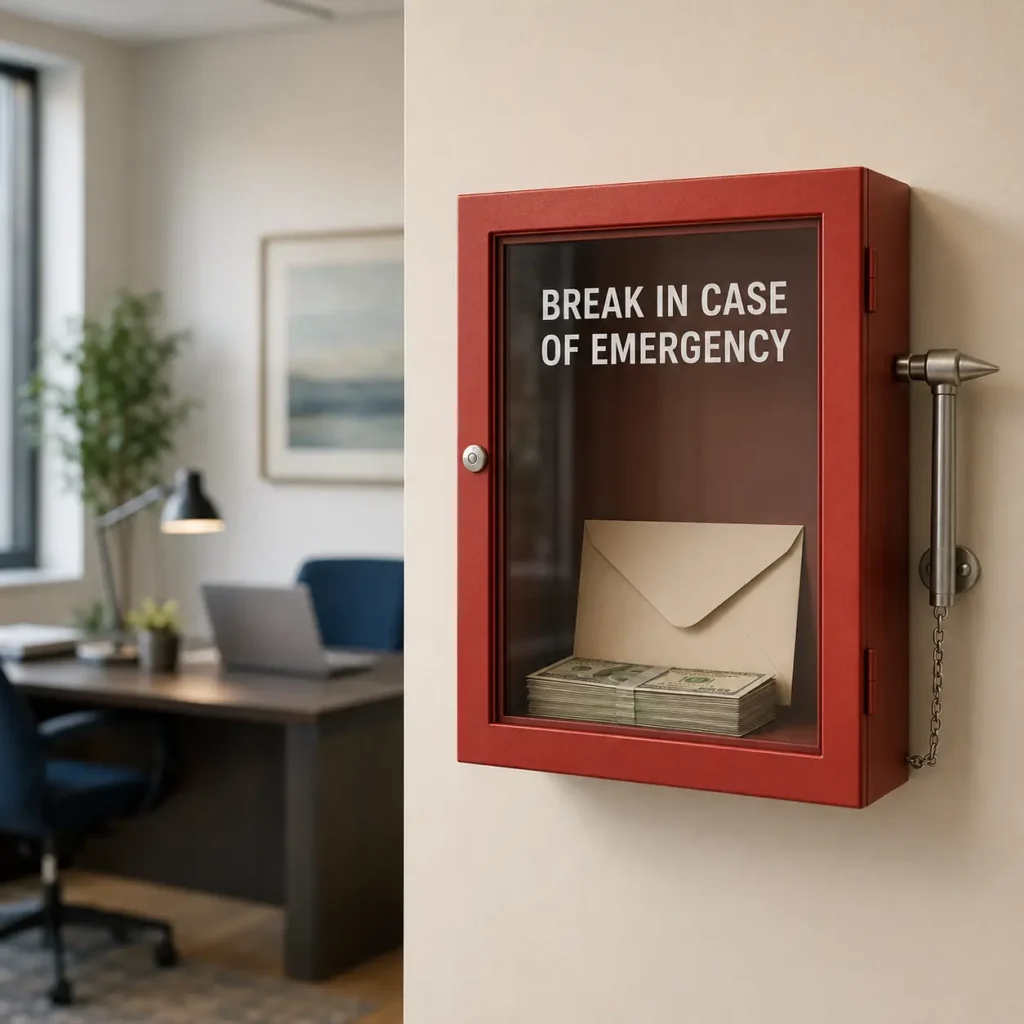
Money doesn’t buy happiness, but it can definitely buy peace of mind. Many times couples come to me feeling uneasy about their financial situation, and my first question will be “Do you have money set aside specifically for emergencies?”
A stable household economy that allows freedom and calm starts with an emergency fund. This is your first line of defense. You start saving an emergency fund the moment you’re out of debt, because debt is a financial emergency and it doesn’t make sense to prepare for an emergency during an emergency.
So assuming you’re at zero or close to it, ask yourselves: Are you prepared for the following situations? And what would the impact on your life be if they happened tomorrow?
- The washing machine broke down and isn’t worth repairing
- Your phone got run over
- The car needs repairs
- Your child is sick, you’ve run out of sick days (or you’re self-employed) and you need to stay home with them for a week without working
I would like the answer to these questions for all my readers to be: “Yes, we’re ready. It would be incredibly annoying but financially it won’t really change our situation.” Sound unrealistic? It can be completely real.
The tool that makes this magic happen is called an “emergency fund.” An emergency fund is liquid, available money that sits on the side just waiting for all these situations. I often hear the expression “white money for a black day,” which is also very accurate. By the way – some say an emergency fund does to Murphy’s Law what garlic does to vampires 🙂
You need to save the emergency fund shekel by shekel and it takes time. Even if it feels like a delay in financial progress, this is a step I would never skip under any circumstances, ever! Emergencies, surprises, and changes of plan can disrupt any financial plan if you’re not prepared for them. And these things always happen. There’s no person in the world who manages to implement their financial plan perfectly without surprises along the way, so part of the financial plan is preparing for life’s curveballs.
What’s the principle here?
You must have money ready on the side for emergencies. Otherwise there will be trouble. Start saving this money immediately after you finish paying off all debts.
Want to know how much money you need for emergencies, and where to keep it? Keep reading.
How Much Money Should You Keep on the Side?
You fill an emergency fund once, and only touch it in an emergency – but how do you know it’s “full”?
The rule of thumb says: the emergency fund should contain the amount you spend in a month, multiplied by three to six months. In other words, your monthly expenses should be multiplied by between three and six months.
How do you decide which point in the range between 3 to 6 months is right for you?
If you have children or someone else who depends on your income, or if it would take you more than three months to find a new job in case you’re fired or leave, or if you have financial commitments like a mortgage – all of these are reasons to add an additional month of expenses to your emergency fund calculation.
Here are some examples of different situations and the months of living expenses they require:
- Students who rent and whose lives are flexible – can make do with money sufficient for three months of living expenses in the emergency fund.
- A family with two children and a mortgage needs to keep money sufficient for six months of living expenses in the emergency fund.
The beauty of this calculation is that it’s very flexible and can change according to your standard of living and personal situation. The amount you need to keep in the emergency fund will usually range between 30,000 NIS to 180,000 NIS. This is a very wide range, reflecting how different the financial lives of different people are.
How Do You Save for an Emergency Fund?
Designate a special item in your expense plan for emergency savings. The more you save each month, the faster you’ll complete this task.
Where Do You Keep an Emergency Fund?
The emergency fund must be very accessible and liquid, and since it’s our insurance we don’t want to put it in a risky place. This basically leaves us with only two main options: a bank deposit or money market funds.
Does this mean the money in the emergency fund will just sit there and lose value?
To some extent, yes. The money isn’t meant for investment and growth but for insurance.
What return can you make without too much risk?
Money market funds (and this is not a purchase recommendation!!) are an option that provides a return close to the Bank of Israel interest rate. As of 2025 this is about 4%, and that’s not insignificant for liquid money at low risk. Some banks and digital wallets provide returns on savings – but this changes on a monthly basis so it’s not possible to give specific examples that will remain relevant over time.
Step by step
- First thing, get out of overdraft and any other debt.
- Define emergency savings – undefined savings will give less peace of mind in case of emergency.
- Calculate how much money you need in savings (= your monthly expenses times 3 to 6).
- Add an emergency savings item to your regular monthly expenses. My advice – be aggressive and try to fill it quickly.
- After the emergency fund is full, there’s no need to add money to it unless you use it.
- Keep the savings in a safe and accessible framework. Use for emergencies only.
Do You Really Need an “Emergency Fund”? Yes. It’s a lifesaver.
I recently worked with a young couple. During the process, it turned out they had saved nice amounts of money, but the savings weren’t defined as savings for a specific purpose (they were debating whether the money would be transferred to investment, property purchase, etc.). As part of our process, we allocated part of this savings for an emergency fund. Two weeks later the husband was fired from his job.
This could have been a serious headache, because unemployment benefits didn’t cover all the salary he was bringing in – but they were prepared! Instead of the husband’s firing turning into an anxiety-inducing situation, they took two days to be upset and then continued with their lives searching for suitable work, in a calm and considered manner.
All’s well that ends well – thanks to the emergency fund, the husband could afford to search for a new job calmly, and do a long process at the end of which he found a job he liked much more, at equivalent pay to what he had.
So, building an “emergency plan” may not be the most exciting part of the financial plan, but in my experience it’s the only thing that buys the most long-term peace of mind. There’s no substitute for the stability of an emergency fund and it will allow you a peace you didn’t know before you allocated the money for this purpose.